Summary:
You’re standing in your driveway looking at a garage full of junk, a kitchen mid-demo, or a roof that needs replacing. You know you need a dumpster. But which size? Rent too small and you’re stuck with overflow or paying for a second haul. Rent too large and you’re throwing money at empty space. This dumpster size chart cuts through the confusion. You’ll see exactly what fits in each container, which projects match which sizes, and how to avoid the weight limit traps that catch most first-time renters. Let’s start with the basics.
How Dumpster Sizes Are Measured and What the Numbers Actually Mean
Dumpster sizes are measured in cubic yards. That’s the volume of space inside the container, not the weight it can hold or the physical footprint on your driveway. One cubic yard equals a 3-foot cube. Picture a standard washing machine—that’s roughly one cubic yard.
A 10-yard dumpster holds 10 cubic yards of material, which translates to about three or four pickup truck loads. A 20-yard holds around six to eight pickup truck loads. The “yard” number tells you capacity, but it doesn’t tell you everything. Weight limits, dimensions, and what you’re actually throwing away all factor into whether a size works for your project. Most people focus only on volume and forget that heavy materials like concrete or roofing shingles max out the weight limit long before the container looks full.
Understanding Weight Limits vs. Volume Capacity
Here’s where most people get tripped up. Every dumpster has two limits: how much space it offers and how much weight it can legally haul. You can max out one without touching the other.
Let’s say you rent a 20-yard dumpster with a 2-ton weight limit. That container can hold six pickup truck loads of light debris like drywall, wood, or household junk without hitting the weight cap. But if you’re tossing in roofing shingles, concrete, or dirt, you might fill only half the container before you exceed the weight allowance. When that happens, you pay overage fees—typically $50 to $100 per ton depending on your location.
Weight matters more than most renters realize. Shingles from a 2,500-square-foot roof can weigh several tons. A dumpster that looks half-empty might already be overweight. That’s why it’s critical to think about what you’re disposing of, not just how much of it there is. Heavy materials need smaller containers with higher weight limits or strategic loading to avoid surprise charges at pickup.
Mixing materials helps. If you’re doing a renovation that produces both heavy debris (tile, concrete) and light waste (cardboard, wood), you can distribute the weight more evenly and stay within limits. But if your project is mostly one type of heavy material, plan accordingly. Ask us what’s included in the base price and what triggers extra fees. We’ll walk you through it instead of underselling you to win the job.
Driveway Space Requirements and Placement Considerations
Before you pick a size, make sure it actually fits where you need it. Dumpsters aren’t just dropped off—they’re delivered by roll-off trucks that need room to maneuver. Most deliveries require about 60 feet of straight-line clearance, 10 to 12 feet of width, and 20 to 25 feet of overhead space for the lifting mechanism.
A 10-yard dumpster typically measures around 14 feet long by 8 feet wide. A 20-yard stretches to about 22 feet long by 8 feet wide. If your driveway is narrow, sloped, or blocked by low-hanging tree branches or power lines, delivery becomes tricky. Measure your space before you order. Walk the path the truck will take and look for obstacles.
Driveway protection matters too. A fully loaded dumpster can weigh several tons, and even the wheels can gouge asphalt or crack concrete if the weight isn’t distributed properly. Smart renters lay down plywood or protective boards under the container to prevent damage. We include this protection automatically with every delivery at no extra charge.
If your driveway won’t work, consider street placement. That usually requires a permit from your local municipality, and there are rules about how far the dumpster must sit from fire hydrants, corners, and crosswalks. HOAs often have their own restrictions too. Check those requirements early so you’re not scrambling the day before delivery. Charleston County has specific permitting processes depending on whether you’re in the city limits or unincorporated areas, so it pays to confirm what applies to your address.
10 Yard Dumpster Rental: Best Uses and Project Matches
A 10-yard dumpster is the smallest standard roll-off size, and it’s perfect for projects that don’t generate massive amounts of waste but still produce more than your weekly trash pickup can handle. Think small bathroom remodels, garage cleanouts, or single-room decluttering. It holds about three to four pickup truck loads, which sounds modest but covers a surprising amount of debris when you’re not tearing down walls or replacing a roof.
This size also works well for heavy materials. If you’re disposing of concrete, dirt, brick, or tile, a 10-yard container keeps you within weight limits without paying for unused volume. Contractors often use 10-yard dumpsters for jobs where the debris is dense and the space is tight.
15 Yard Dumpster Rental: The Middle Ground for Medium Projects
The 15-yard dumpster sits between the 10 and the 20, offering a little more breathing room without jumping to a significantly larger footprint. It holds about four to five pickup truck loads and works well for projects like deck removal, flooring replacement, or medium-sized garage cleanouts.
This size is popular with homeowners who know they’ll generate more waste than a 10-yard can handle but don’t need the full capacity of a 20-yard. It’s also a smart choice when driveway space is limited. A 15-yard dumpster is typically around 16 feet long, so it fits in tighter spots than the 22-foot length of a 20-yard.
Contractors use 15-yard containers for fence removal, carpet and hardwood flooring jobs, and small landscaping projects. The capacity is enough to handle bulky materials without being oversized for residential driveways. If you’re cleaning out multiple rooms or tackling a project that falls somewhere between minor and major, this is often the sweet spot.
One thing to watch: if you’re unsure whether a 15-yard will be enough, it’s usually smarter to size up to a 20-yard. The cost difference is often minimal, and running out of space mid-project means either overfilling (which triggers fees) or scheduling a second delivery (which costs more than renting the right size from the start). Think about your timeline too. If your project will stretch over several days and debris will accumulate gradually, having extra capacity prevents stress and keeps the worksite clean.
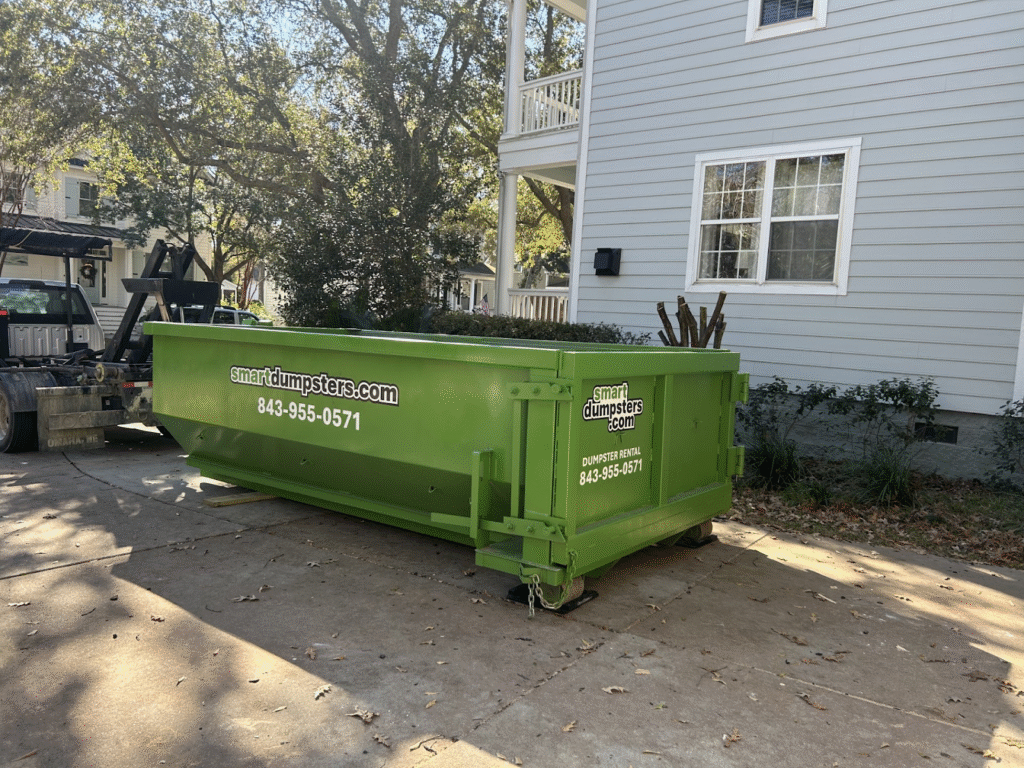
What Fits in a 10-Yard Container and What Doesn't
A 10-yard dumpster can hold the contents of a small bathroom remodel—old vanity, toilet, tile, drywall, and fixtures. It can handle a garage cleanout with boxes, old furniture, lawn equipment, and general household clutter. It works for yard projects involving branches, sod, or dirt, as long as the material isn’t excessively heavy.
What doesn’t fit: a full kitchen remodel, a roof replacement on anything larger than a small shed, or a multi-room renovation. If you’re gutting more than one space or dealing with bulky items like mattresses, couches, and appliances all at once, you’ll outgrow a 10-yard quickly. Same goes for projects that produce a lot of wood framing, drywall, or insulation. Those materials are light but take up space fast.
Weight is the real limiting factor with a 10-yard. Most come with a 1 to 2-ton weight allowance. If you’re tossing in concrete pavers, asphalt, or roofing shingles, you’ll hit that limit before the container looks even half full. For heavy debris, this size is actually ideal because it prevents you from overloading and triggering overage fees. But for mixed or light materials, you might need more volume. Think about what’s coming out of your project, not just how big the pile looks. Dense materials need small containers. Bulky materials need bigger ones.
20 Yard Dumpster Rental: The Most Popular Size for Home Projects
The 20-yard dumpster is the workhorse of residential projects. It’s the most commonly rented size because it handles a wide range of jobs without being too big for a standard driveway. It holds about six to eight pickup truck loads, which covers most kitchen remodels, bathroom renovations, roofing projects, and medium-sized cleanouts.
This size balances capacity and convenience. It’s large enough to handle demolition debris, old cabinets, countertops, flooring, and fixtures from a full room tear-out, but it still fits in most driveways and doesn’t require special placement. Contractors use 20-yard dumpsters for roof replacements on average-sized homes, deck removals, and flooring jobs that span multiple rooms.