Summary:
You picked the right size dumpster for your project. You loaded it carefully, keeping everything below the fill line. Then the bill arrives, and there’s an extra $200 charge you weren’t expecting.
That’s the weight limit talking. And if you didn’t know it was there, you’re not alone. Most people focus on whether their debris will fit, but landfills don’t charge by volume. They charge by the ton. Understanding dumpster weight capacity before you start loading can save you from overage fees that turn an affordable rental into an expensive surprise. Here’s what actually matters when it comes to weight limits, how they’re measured, and how to stay under your allowance without leaving half your debris behind.
How Dumpster Weight Limits Actually Work
Every dumpster rental comes with two limits: how much space it holds and how much weight it can carry. The space part is straightforward. A 20 yard dumpster holds 20 cubic yards of material. Simple.
Weight is different. Your rental includes a set tonnage allowance, usually between 1 and 5 tons depending on the container size and what you’re throwing away. That allowance is built into your quoted price. If your debris weighs more than that limit, you pay extra. And you won’t know you went over until after pickup, when the dumpster gets weighed at the landfill.
Here’s how it works. When the truck picks up your full dumpster, it drives onto a scale at the landfill or transfer station. They record the total weight of the truck, dumpster, and your debris. Then they dump your load and weigh the empty truck and dumpster again. The difference between those two numbers is your debris weight. If that number exceeds your included tonnage, the overage charge gets added to your bill.
20 Yard Dumpster Weight Limit
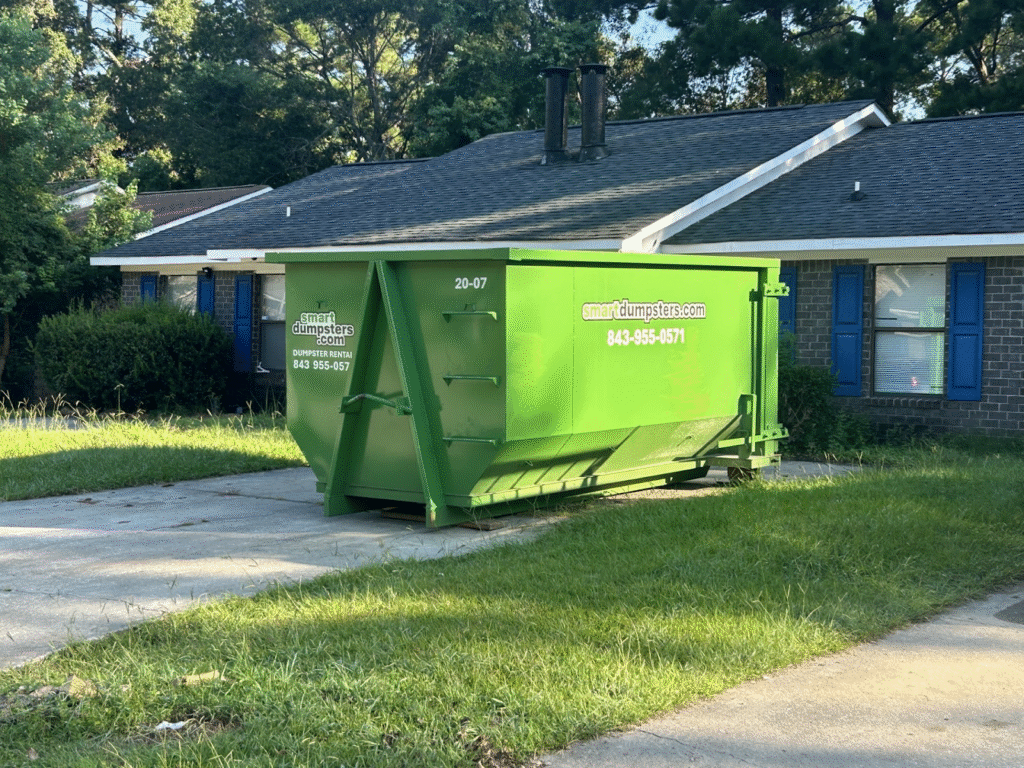
A 20 yard dumpster typically includes 2 to 3 tons of disposal in the base price. That’s 4,000 to 6,000 pounds of debris before you hit overage territory.
For most residential projects, that’s plenty. If you’re clearing out a garage, remodeling a kitchen, or removing old carpet and drywall, you’ll likely stay well under the limit. Light household junk, furniture, and general construction debris don’t weigh much relative to the space they take up.
Where people run into trouble is with dense materials. Roofing shingles are a perfect example. A single layer of asphalt shingles on a typical roof weighs around 200 to 250 pounds per roofing square, which is 100 square feet. If you’re tearing off a 2,000 square foot roof, that’s 20 squares, which means 4,000 to 5,000 pounds of shingles alone. Add in the felt paper, nails, and ridge caps, and you’re already pushing 3 tons before anything else goes in.
Same thing with concrete, brick, or dirt. These materials are incredibly heavy for their size. Just three cubic yards of broken concrete can weigh 12,000 pounds, which is 6 tons. That’s double the typical weight limit for a 20 yard dumpster, even though it only fills a fraction of the space.
The takeaway here is that a 20 yard dumpster works great for bulky, lightweight debris. But if your project involves heavy materials, you need to think about weight first and space second. You might fill the dumpster halfway and still be over the limit.
We include 2 tons with every 20 yard rental and charge a clear $80 per ton for anything over. No surprises, no fine print. You know the limit upfront, and if you go over, you only pay for the extra tonnage you actually used.
30 Yard Dumpster Weight Limit
A 30 yard dumpster usually comes with a weight limit of 3 to 5 tons, or 6,000 to 10,000 pounds. That’s more capacity than a 20 yarder, but the same rules apply. Dense materials fill your weight allowance faster than the physical space.
This size is popular for whole-home cleanouts, large renovations, and commercial projects. You’ve got room for bulky items like old furniture, cabinets, and framing lumber, plus the tonnage to handle a reasonable amount of heavier debris mixed in.
But here’s where people make mistakes. They assume that because they’re renting a bigger dumpster, they can load it with anything. So they toss in drywall, tile, hardwood flooring, and maybe some leftover concrete from a patio demo. Each of those materials adds weight fast.
Drywall, for example, weighs about 1,950 to 2,650 pounds per 1,000 square feet of half-inch material. Tile runs even heavier, especially porcelain or natural stone. If you’re demoing multiple rooms, you’re looking at several thousand pounds just from those two materials. Add wet drywall from a bathroom or basement, and you’ve easily added 20 to 50 percent more weight because moisture soaks into porous materials.
The 30 yard size gives you flexibility, but it doesn’t give you unlimited weight. If your project involves a lot of dense debris, talk to your rental company before you start loading. We can help you figure out whether you need a higher weight limit, a second dumpster, or a specialized container for heavy materials.
And don’t forget about moisture. If it rains during your rental period and you haven’t covered the dumpster, that water adds up. A single inch of rain in a 30 yard dumpster can add nearly 150 gallons of water, which weighs over 1,200 pounds. That’s more than half a ton, just from one rainstorm. Cover your dumpster with a tarp if you’re disposing of materials that absorb water, or schedule pickup before bad weather hits.
What Really Affects Your Dumpster Weight
Three things determine whether you stay under your weight limit: the type of material you’re throwing away, how much moisture it contains, and how tightly you pack the dumpster.
Material type is the biggest factor. Concrete, asphalt, brick, stone, dirt, and sand are all extremely dense. They weigh thousands of pounds per cubic yard, which means even a small amount can max out your tonnage allowance. On the other end of the spectrum, you’ve got yard waste, cardboard, furniture, and general household junk. These materials are light. You can fill an entire dumpster with them and still stay well under your weight limit.
Moisture changes everything. Dry wood weighs around 300 to 600 pounds per cubic yard. Wet wood can weigh twice that. Same with drywall, insulation, carpet, and yard debris. If you’re loading materials that have been sitting outside, or if it rains during your rental period, expect the weight to go up significantly.
Packing density also matters. If you’re breaking down materials and stacking them tightly, you’ll fit more weight into the same space. That’s not necessarily a problem if you’re dealing with lightweight debris, but if you’re compacting heavy materials, you can easily go over your limit without realizing it.
40 Yard Dumpster Weight Limit
A 40 yard dumpster is the largest size most rental companies offer, and it typically includes 4 to 5 tons of disposal, or 8,000 to 10,000 pounds. This size is built for major demolition jobs, large commercial projects, and situations where you’ve got a high volume of lightweight debris.
But here’s the thing. Just because you’re renting the biggest dumpster doesn’t mean you can load it with the heaviest materials. In fact, the opposite is often true. If you’re disposing of concrete, dirt, or roofing debris, you’ll hit the weight limit long before you fill the container.
Most roll-off trucks can legally haul up to 10 tons, or 20,000 pounds, but that’s the absolute maximum. If your dumpster exceeds that limit, the driver can’t take it. You’ll either need to remove some of the debris or pay for a second trip, which means extra fees on top of the overage charges.
For projects that involve a lot of heavy materials, a smaller dumpster is often the smarter choice. A 10 or 20 yard container designed for heavy debris can handle the weight without putting you at risk of going over the legal limit. Some companies even offer specialized heavy debris dumpsters that are built to carry up to 10 tons in a compact size.
If you’re working on a project in Charleston County and you’re not sure which size makes sense, talk to a local company that knows the area. We’ve seen hundreds of projects like yours and can give you a realistic estimate based on what you’re throwing away.
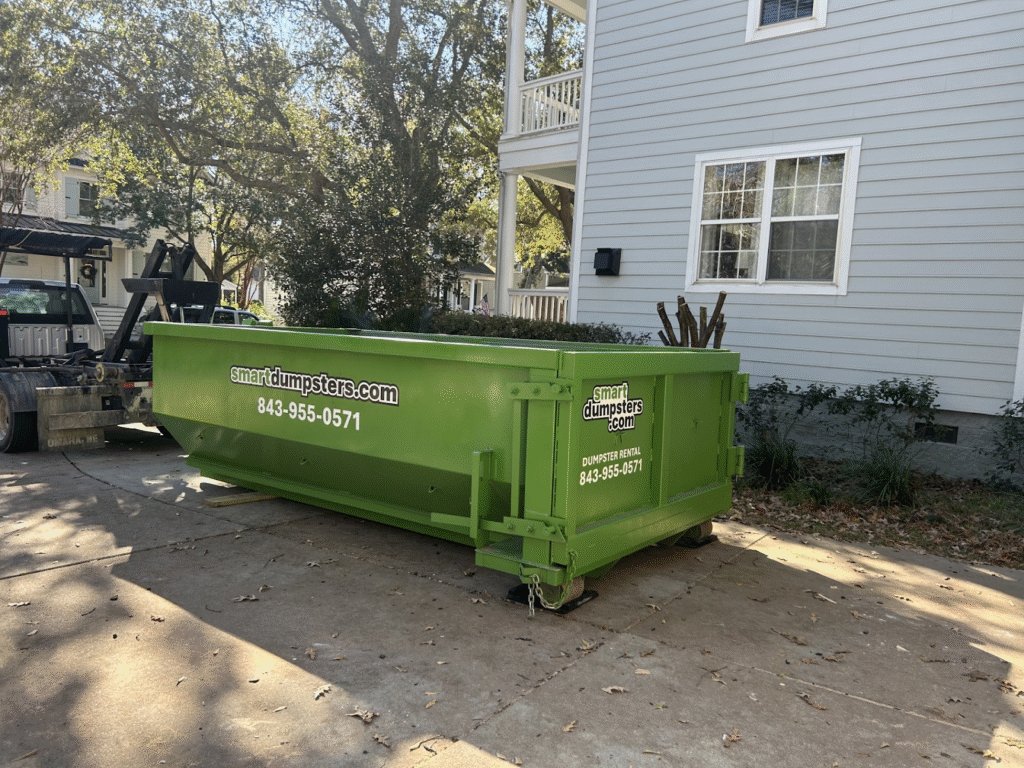
We serve Charleston, Berkeley, and Dorchester Counties and offer three sizes: 10, 15, and 20 yard containers. All sizes include 2 tons of disposal, with extra weight charged at $80 per ton. That’s straightforward pricing with no hidden fees, and it’s designed to work for the kinds of projects people in this area actually do.
How to Estimate Your Debris Weight Before You Load
You don’t need a scale to get a rough idea of how much your debris weighs. You just need to know what you’re throwing away and how much of it you have.
Start with the material type. Concrete weighs about 4,000 pounds per cubic yard. Asphalt is similar. Brick runs around 3,400 pounds per cubic yard. Dirt and sand are in the same range. If you’re disposing of any of these materials, you’re looking at serious weight even in small quantities.
On the lighter side, household junk weighs around 300 to 800 pounds per cubic yard. Yard waste is 400 to 1,500 pounds per cubic yard, depending on whether it’s dry leaves or wet branches. Drywall is about 500 pounds per cubic yard for standard half-inch material.
Once you know the weight per cubic yard, estimate your volume. If you’re tearing out a concrete patio that’s 10 feet by 10 feet and 4 inches thick, that’s roughly 1.2 cubic yards of concrete. At 4,000 pounds per cubic yard, you’re looking at about 4,800 pounds, or 2.4 tons. That’s already over the base limit for most 20 yard dumpsters.
If math isn’t your thing, just reach out to your rental company. A good local provider has seen hundreds of projects and can give you a ballpark estimate based on what you’re working on. We’ll ask about the type of debris, the size of the area you’re clearing, and whether the materials are wet or dry. From there, we can recommend the right dumpster size and weight limit for your job.
And if you’re still not sure, it’s better to overestimate than underestimate. Renting a dumpster with a higher weight limit costs a little more upfront, but it’s cheaper than paying overage fees after the fact. Most companies charge $50 to $100 per ton for weight overages, and those charges add up fast if you’re several tons over your limit.
Avoiding Weight Overage Fees Comes Down to Planning
Dumpster weight limits aren’t there to trick you. They exist because landfills charge by the ton, and rental companies need to cover those costs. But if you don’t know the limit exists, or you don’t understand how quickly heavy materials add up, you’re going to get hit with fees you didn’t see coming.
The fix is simple. Know your weight limit before you start loading. Understand which materials are heavy and which ones aren’t. Cover your dumpster if rain is in the forecast. And if you’re not sure whether your debris will stay under the limit, talk to your rental company before pickup.
We make this easy. Every rental includes 2 tons of disposal, and if you go over, it’s $80 per ton with no surprises. You get same-day delivery when you book in the morning, free driveway protection boards, and automated updates so you always know what’s happening. It’s dumpster rental done right, by people who live and work in Charleston County and understand what local projects actually look like.